
AI.bomb
Burry is shorting Nvidia, Goldman is publishing notes called "AI-nxiety" and Damodaran is predicting a correction worse than dot-com. But a correction and a bubble are not the same thing.
Fall in token prices since GPT-4 launched
Jump in monthly tokens processed, April 2024 to October 2025
Anthropic annualised revenue, up from $87m in early 2024
There isn't an AI bubble.
Probably.
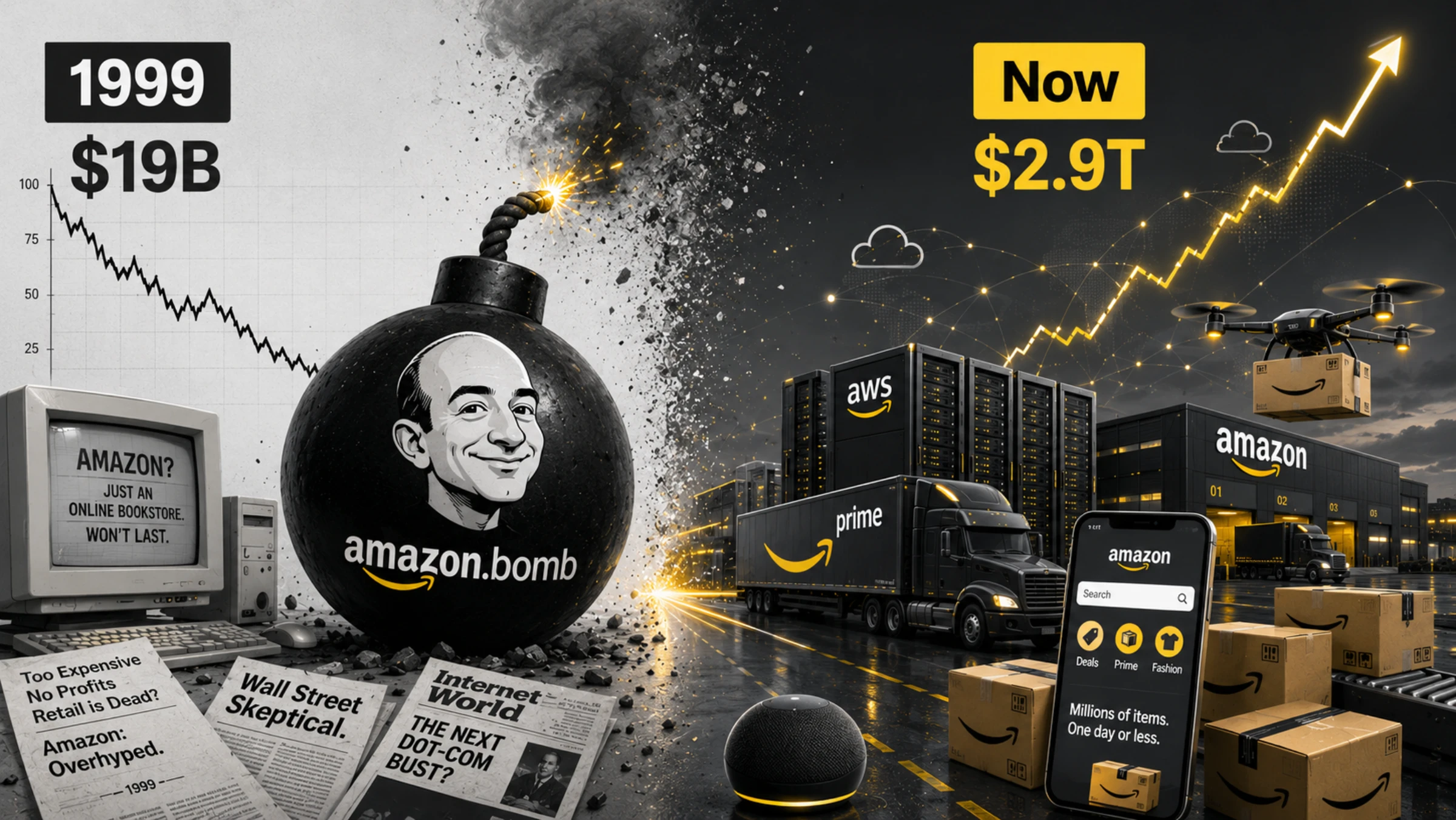
In May 1999, Barron's ran a cover story called "Amazon.bomb", with Jeff Bezos's face drawn onto a cartoon bomb. "The idea that Amazon CEO Jeff Bezos has pioneered a new business paradigm is silly," wrote Jacqueline Doherty. "He's just another middleman, and the stock market is beginning to catch on to that fact." Amazon was worth about $19 billion that day. It's worth around $2.9 trillion now.
The bubble talk has picked back up again this month. Burry buying puts against Nvidia. Goldman publishing a note called "AI-nxiety". Damodaran predicting a correction worse than dot-com. Started to wonder if I was missing something obvious.
I don't think I am, but bear with me.
A bubble and a correction aren't the same thing.
A bubble is the dot-com kind: prices detach from real demand and the crash takes a generation to clear. Cisco shareholders waited 25 years to break even on a company that, by every other measure, did fine. A correction is when valuations get ahead of fundamentals and reset on the way to a much larger market.
People were buying nothing in 1999. People are buying a lot of something in 2026, possibly at a silly price.
The something is tokens.
Token prices have fallen roughly 99% since GPT-4 launched. Consumption hasn't fallen with them. Google was processing 9.7 trillion tokens a month in April 2024. By October 2025 it was at 1.3 quadrillion. A 130x jump in 18 months while prices kept falling. That isn't what a top looks like.
And someone's paying for those tokens. Anthropic went from $87 million in annualised revenue in January 2024 to $30 billion by April 2026. Salesforce took 20 years to do the same. OpenAI is doing roughly $25 billion at a similar pace.
(Sorry, I'm about to say Jevons paradox.)
When 19th-century steam engines got more efficient, Britain didn't burn less coal. It burned much more, because cheaper energy unlocked uses that had been uneconomic before. Cheaper tokens probably do the same thing. They don't shrink the AI budget, they expand the list of things worth doing with AI.
The unit of work has changed, too.
From a query to an agent.
In 2023 the unit was a chatbot query: a few thousand tokens, a few seconds, one human typing at one model. In 2026 it's an agent doing a multi-step task: 200,000 tokens, dozens of tool calls, hundreds of model invocations.
And agents are still getting longer time horizons. A coding agent that runs for ten minutes uses more compute than one that runs for ten seconds. An agent that runs for ten hours uses more again.
The addressable market isn't AI software.
Push the same trend out five or ten years. Most knowledge work mediated by agents. Most software interfaces replaced by a model call. A lot of stuff humans never bothered to do at all due to the impossibility, reviewing every Roblox chat message for abuse, say, now done continuously and cheaply.
It's roughly cognitive labour, plus all the things we never had cognitive labour for. Could I be wrong about that? Sure. It would require the curve to break, and so far it isn't.
Valuations look stretched on a one-year view and reasonable on a ten-year view.
The other bear staple is the cash burn. OpenAI lost $9 billion in 2025 and isn't expected to be cash-flow positive until 2030. Sounds damning. It's also just what VCs do, just on a bigger scale than ever before, because the opportunity is bigger than ever before.
Amazon didn't post a full year of profit until 2003, nine years in. AWS launched in 2006 and didn't show clean segment profitability until 2015, by which point most people had stopped asking whether it would work.
Of course, I have to bring up Uber as an example. Hubert Horan spent years writing rigorous analyses of why the unit economics didn't work, and he was largely right about the Uber he was writing about. By 2023 the company had killed its self-driving unit, exited China and Southeast Asia, raised fares more than 50%, launched a subscription and built an ads business. First annual operating profit that year: $1.1 billion. By 2025: $5.57 billion in operating income and $9.76 billion in free cash flow.
OpenAI in 2030 won't look much like OpenAI today.
So yes, probably drawdowns coming. The circular deals between Nvidia, OpenAI, Oracle and CoreWeave will look ugly the moment OpenAI's revenue ramp stalls for a quarter. A blip in the grand scheme of where this is all heading.
Look ten years out. Does anyone think AI won't be in everything by then, including cars and humanoid robots?
The goalposts for what counts as intelligence will keep moving, because the genie is out of the bottle and there are trillions of dollars chasing superintelligence. Nobody is giving up after this amount of progress in such a short period of time.