Waymo has driven over 220 million miles with nobody in the driver's seat, and by its own published analysis its cars have been in 94% fewer crashes causing serious or fatal injury than human drivers on the same roads. At least a dozen people are using Neuralink implants to browse the internet, play chess and control a cursor with their thoughts. Casgevy, the first approved CRISPR therapy, is curing sickle cell patients by editing their own cells.
None of that was true five years ago. Most of the AI conversation has been about job losses and cheating on essays.
Most making the bold predictions below is talking their own book. Sam Altman owns roughly a third of a fusion company he publicly backs. Elon Musk needs someone to buy the ten billion robots he's forecasting. Jensen Huang's chips get more valuable every time someone believes robotics is about to boom. Kurzweil built a personal brand on being the guy who called the future.
Still, this isn't a handful of billionaire/trillionaire enthusiasts. Private fusion companies have raised more than $13 billion, with Commonwealth Fusion Systems on close to $3 billion and Helion, the company Altman owns a third of, valued at $15.5 billion in June. Figure AI raised $675 million from Microsoft, OpenAI, Nvidia, Amazon and Jeff Bezos personally in early 2024, then over $1 billion at a $39 billion valuation nineteen months later. Neuralink is valued at around $9 billion.
Every child gets a tutor
Sal Khan predicts a patient, personalised AI tutor for every student and an assistant that takes admin off every teacher's plate. Khan Academy's own tool, Khanmigo, is already used by around two million students and teachers across the US, India, Brazil and the Philippines. One-to-one tutoring has always worked, but been too expensive to give to everyone.
Medical progress
DeepMind's AlphaFold predicted the structure of almost every known protein, has been used by more than three million researchers, and won Demis Hassabis a share of the 2024 Nobel Prize in Chemistry. Dario Amodei believes once AI is capable enough, it could compress fifty to a hundred years of medical progress into five to ten.
Jennifer Doudna, who co-invented CRISPR-Cas9, expects the next advance to move beyond rare genetic disease into microbiome editing and preventive medicine.
Brain interfaces
Edward Chang's lab at UCSF has built neuroprostheses that turn brain signals directly into text and speech. Synchron threads its device into the brain through a blood vessel rather than opening the skull, and its patients already control phones and computers this way.
More robots
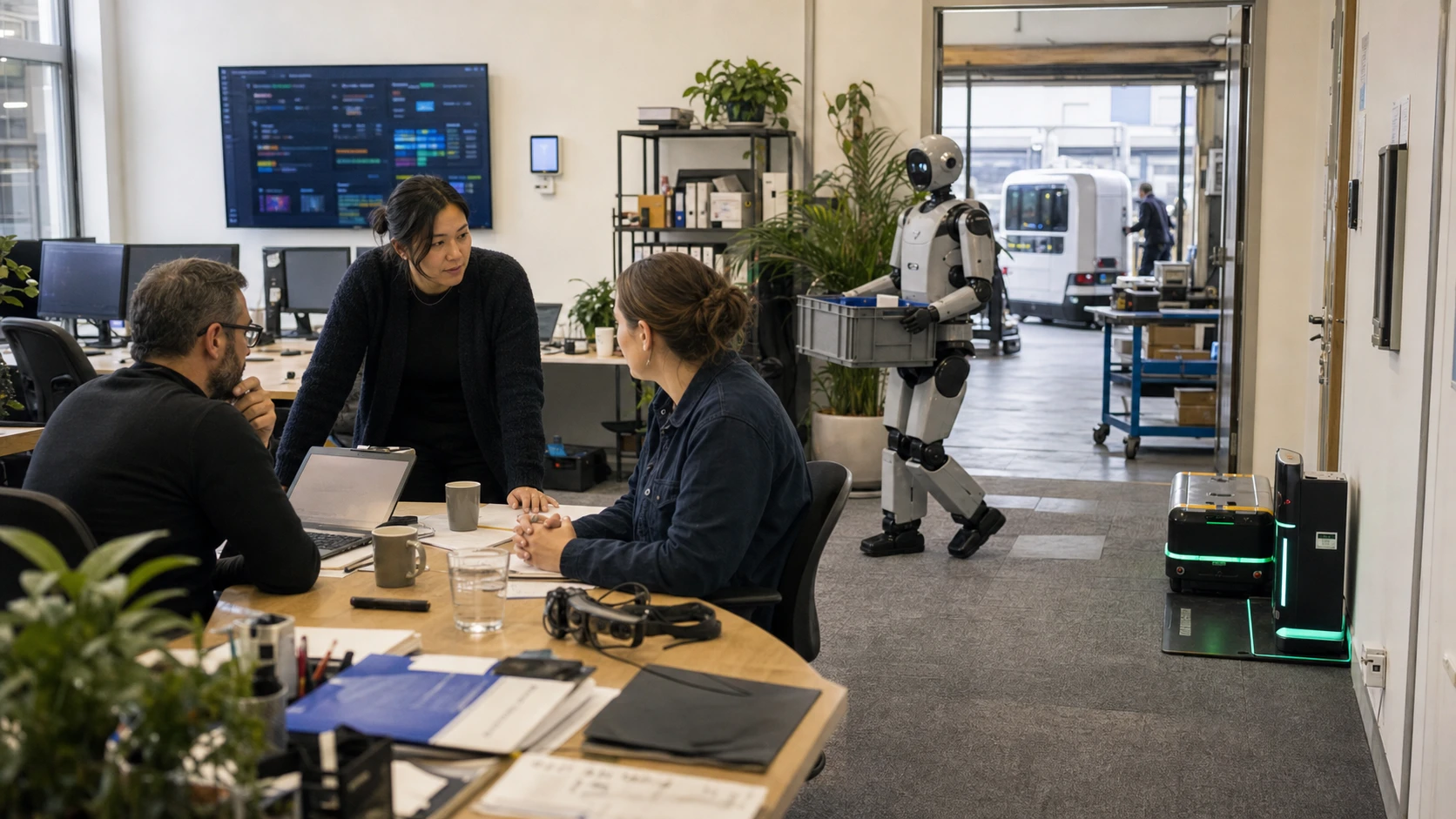
Jensen Huang says every company handling physical goods eventually becomes a robotics company. Figure's robot spent eleven months on a live BMW line, loading sheet metal for more than 30,000 X3s, and its successor has since taken over at the same plant. Toews expects over 100,000 humanoid robots at work by 2030. Musk has predicted 10 billion by 2040 at around $20,000 to $25,000 each… his dates are usually early.
Cars
Waymo's mile count and crash rate are public record. It raised $16 billion in February at a $126 billion valuation, already doing more than 400,000 rides a week. Goldman Sachs expects the global robotaxi market to reach roughly $415 billion by 2035. Those who try it, don’t want to go back.
Ageing as an engineering problem
XPRIZE Healthspan is a $101 million competition aimed at restoring a decade of muscle, cognitive and immune function in people aged 50 to 80. Kurzweil predicts "longevity escape velocity" around 2029, the point where medicine adds more than a year of life expectancy per year.
Energy
The US Department of Energy is targeting commercial fusion on the grid in the 2030s. Helion has a Microsoft deal targeting 2028. The International Atomic Energy Agency puts commercial fusion in the second half of the century.
Robot labs
Self-driving labs let a researcher set a goal and hand off to a machine that proposes an experiment, runs it, reads the result and goes again, overnight. NC State's PoLARIS lab searched billions of possible recipes and found brighter lead free nanomaterials in about 120 experiments over 12 hours. Work that used to take a PhD length of time (and PhD intelligence in that area) now takes a weekend.
Water
Researchers at the University of Rochester have built a solar desalination system that makes drinking water with no chemical additives and no toxic brine going back into the sea, collecting the salts as solids instead. Omar Yaghi's Atoco is building machines that pull clean water out of dry air.
The jobs nobody can picture yet
But what happens to work?
Naval Ravikant says pessimism just takes less imagination. Spotting a job that's about to disappear is easy. Naming the one that replaces it is hard, yet something always turns up. Nobody two centuries ago, when almost everyone worked the land, could have named a fraction of the jobs that exist now.
Write a job advert for 2049: Synthetic Lineage Officer, hybrid, £115,000 to £145,000, owning the compliance chains between an organisation's AI agents and the humans accountable for them. Reads as nonsense today (and probably is, which is the point of this exercise). So would "Customer Success Manager" in 1985.
"The goal is not to have to get up at nine in the morning and come back at 7 PM exhausted, doing soulless work for somebody else."
Naval Ravikant · A Motorcycle for the Mind"The goal is to have your material needs solvable by robots, to have your intellectual capabilities leveraged through computers, and for anybody to be able to create."
Naval Ravikant · A Motorcycle for the MindThe optimistic case is not that disruption will be painless, or that every displaced worker will neatly step into a better-paid job. Hopefully nobody believes that the current jobs are the pinnacle state of humanity. Surely there are more interesting things for our children to become than [INSERT JOB HERE] (I don’t want to offend anyone).
Aside from the fact that the people who are fully embracing AI are working more than ever, human wants are elastic, status games are infinite, and once technology makes one layer of work cheap or unnecessary, we invent another. We did not move from farms to factories to offices because the universe handed us a fixed list of occupations. We made them up, then treated them as obvious. The future probably will not look like today’s labour market with a few new titles bolted on and it may look stranger (from today’s perspective), but no stranger than how people in previous generations looked at our work.
Jeremy Giffon’s mildly spicy take, “Every, certainly every white-collar job is totally fake and made up… we just make up stuff for us to do.”