
The AI hiring paradox: more automation, more people
Companies spending the most on AI are hiring more people, not fewer. That makes sense once you look at what AI makes worth doing, especially for UK SMEs.
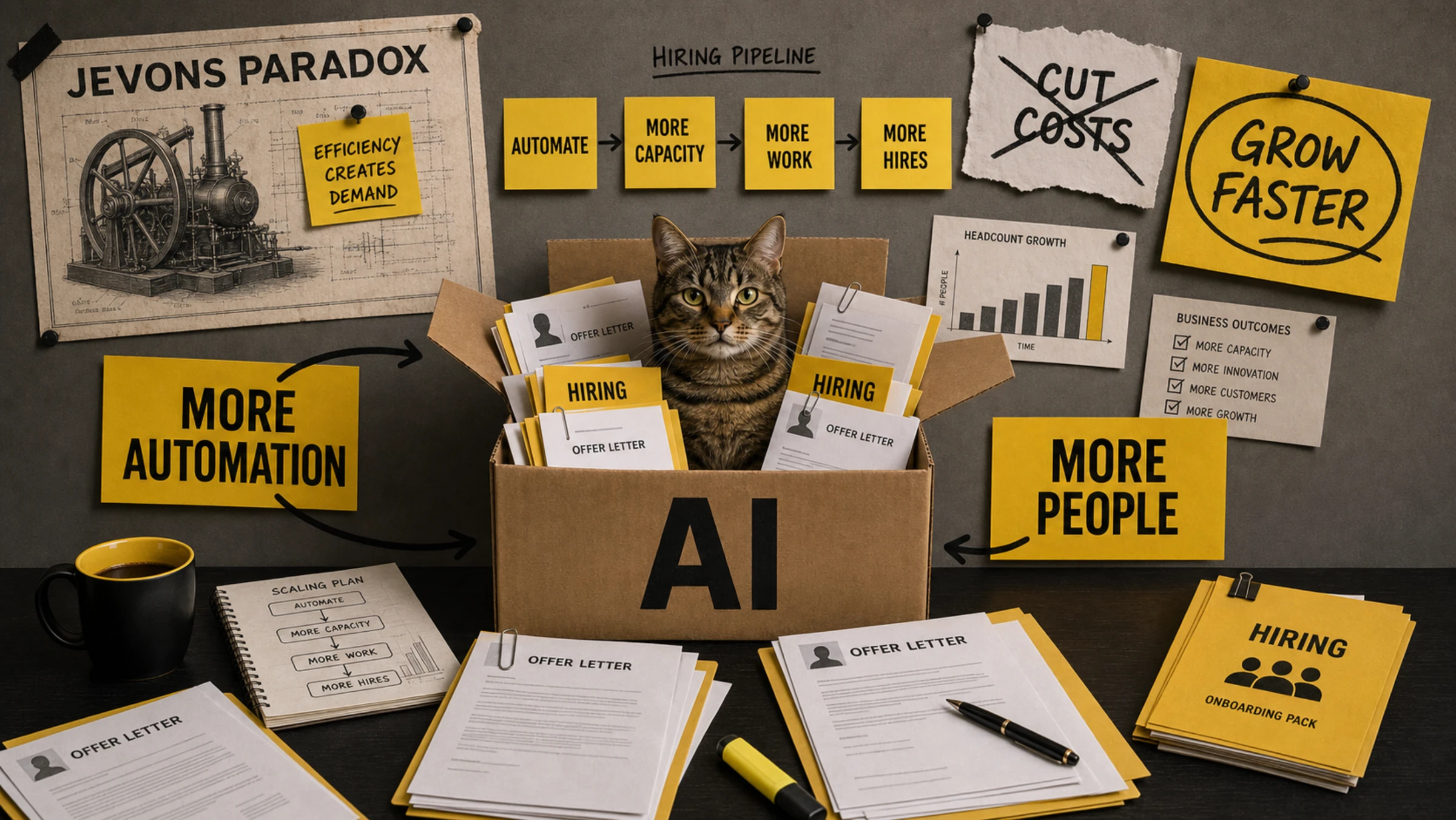
Ramp and Revelio Labs studied more than 21,000 US firms and found the heaviest AI spenders grew headcount by 10.2% in the two years after adoption. Entry-level roles grew by 12%.
That's a strange result if you believe the standard story: AI makes people more productive, so you need fewer of them.
But the same technology gets used two ways. Some CEOs take the productivity gain and run a smaller version of the same business. Others hire more good people and pull further ahead. I think the second group wins, and the Ramp data backs that up.
The companies automating the most are also hiring the most.
Good people just became better investments
Say someone costs you £60,000 a year and produces £120,000 of value. With AI they produce £180,000.
That person is now more valuable, and so is the next one you hire. A developer gets more product out the door. A salesperson can research accounts, personalise outreach, keep the CRM clean and follow up properly. An operations person can build internal tools instead of requesting them. In every case the maths on another hire got better.
Jevons paradox is back
You might remember Jevons paradox from a few months ago, when it briefly became everyone's favourite economics lesson and got typed into more posts than in the previous 150 years combined. When something becomes more efficient, people usually consume more of it. More efficient steam engines meant more coal burned, not less. Then everyone moved on to the next thing.
The hiring data is Jevons again. We've written about this before at Vu in the context of automation. When it becomes cheap to write a proposal, you write more proposals. When it becomes cheap to follow up leads, you follow up all of them instead of the top 20%. When it becomes cheap to build an internal tool, you finally build the ones sitting on the "one day" list for three years.
Most businesses aren't sitting on a fixed pile of work, they're drowning in work they should do but can't justify: leads nobody chased, reports nobody produced, customers nobody checked in with. AI makes more of that work worth doing, and more work needs people to own it.
The constraint moves
When AI takes over a task, the constraint moves somewhere else.
Say AI helps your sales team write better follow-ups. Now lead quality is the constraint, so you improve research. Then speed to quote, so you automate quote generation. Then onboarding, so you fix handover. Then account management, so you build proper check-ins.
That chain ends with more work being worth doing, and another part of the business needing an owner.
Why layoffs still happen
None of this means AI has no effect on jobs. Some tasks will disappear, some roles will be redesigned, and some companies will use it to cut.
The Ramp data has caveats. The heavy adopters were often larger, more technical, more likely to be venture-backed and already growing faster. Low and moderate adopters didn't see the same headcount effect, and Ramp suggests a learning period of six to twelve months before results show up, which most companies won't tolerate.
And honestly, some companies overhired, or built teams around manual processes that should never have existed, and some executives will blame AI for cuts they wanted to make anyway. Ramp makes the same point: be sceptical when a CEO casually credits layoffs to AI, because the firms investing seriously in it are often the ones hiring faster.
PwC's 2026 AI Jobs Barometer found the same thing: the companies most exposed to AI are seeing stronger productivity growth, and the biggest gainers are raising both wages and headcount faster than the least exposed.
The SME version
For SMEs, this is even more obvious. Most were never going to replace departments with AI. They don't have departments. They have five people doing the work of fifteen, a founder replying to enquiries at 10pm, and customer information scattered across inboxes, spreadsheets and people's heads.
For those businesses, the useful AI projects are usually the boring ones: reply to every enquiry, quote every serious lead, summarise every customer call, spot problems before they get expensive. More shots on goal.
It also changes who you want to hire. Someone who "uses ChatGPT" isn't enough. The valuable hires have judgement and ownership: they can look at a messy process, run the tools, check the output and improve the system. AI makes those people more valuable and makes weak systems more obvious. If your processes are undocumented and your data is a mess, it'll surface that on day one.
Most UK companies haven't started
ONS data from April 2026 says 26% of UK businesses report using at least one type of AI technology. Even among businesses with 250 or more employees it's only 45%.
The Ramp results describe serious adopters, and in the UK those are still rare. A good person using AI well can get a long way ahead of competitors who still do everything manually.
There's still time to be early. Not much, though.
SOURCES
- Ramp: Companies hire more after AI adoption
- Ramp Economics Lab: A New Look at AI's Impact on Jobs
- Revelio Labs: Greater AI investment, more hiring
- Financial Times: Heavy corporate AI spenders add staff faster than peers
- PwC 2026 Global AI Jobs Barometer
- ONS: Business insights and impact on the UK economy, 2 April 2026
- Vu Agency: From chat to orchestration